Contact centers are under more pressure than ever. Customers expect fast, personalized, and consistent service across every channel. At the same time, leaders need to control costs, reduce churn, and hit ever-tougher KPIs.
This is where agent assist contact centre technology comes in. Rather than replacing people, it acts like a real-time co-pilot for your agents, helping them respond faster, resolve more, and deliver a better experience on every call, chat, or message. It’s no wonder why businesses choose AI call centers to stay ahead in today’s competitive landscape.
Modern contact centers are increasingly integrating advanced tools to boost productivity and ensure seamless customer interactions. Companies are exploring solutions such as cloud-based computing systems for enterprises that provide scalable support for large volumes of customer data. These systems allow agents to access critical information instantly, reducing response times and enhancing customer satisfaction.
In addition, some organizations invest in high-performance supercomputers for customer analytics to process complex datasets and deliver actionable insights. By leveraging this technology, businesses can anticipate customer needs and proactively address issues before they escalate.
Marketing strategies also play a crucial role in customer engagement. Agencies like Marketing for Customers provide tailored solutions that align promotional campaigns with real-time customer behavior. This ensures that messages are relevant, timely, and drive meaningful interactions. Similarly, top marketing automation runners in the industry help streamline communication across multiple channels, giving agents more time to focus on personalized service.
Financial considerations cannot be overlooked either. Tools from Top Financial Resources assist organizations in managing operational costs while optimizing the customer experience. By monitoring budgets, predicting expenditure, and evaluating ROI, leaders can make smarter decisions and allocate resources where they matter most.
Together, these technologies and strategies create a robust ecosystem where agent performance is amplified, and customer satisfaction thrives. Implementing an AI-powered agent assist system within this environment ensures that every interaction is efficient, informed, and leaves a lasting impression.
Top 10 Agent Assist Contact Centre PlatformsWhen it comes to improving efficiency and customer satisfaction, businesses are increasingly turning to agent assist contact centre solutions. These platforms help agents respond faster, access real-time insights, and deliver consistent experiences across calls, chats, and messages. Below is a list of the leading platforms in the market today.
1. Bright Pattern
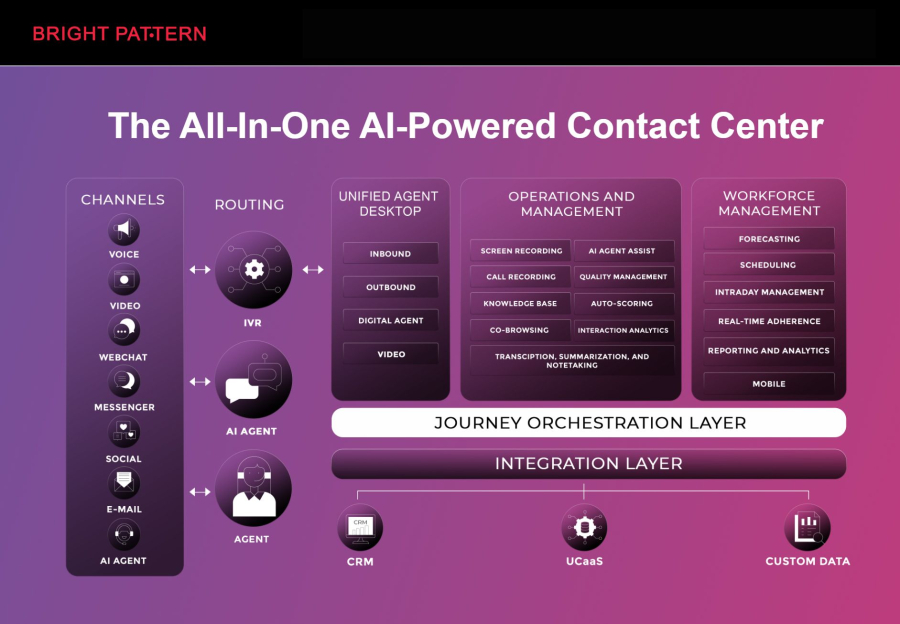
Bright Pattern is a top-rated agent assist contact centre platform that empowers agents with AI-driven tools to enhance every customer interaction. It provides a seamless omnichannel experience and integrates advanced analytics for smarter decision-making.
Key features of Bright Pattern include:
- Real-time agent assist to suggest responses and actions during live interactions
- Omnichannel support for voice, chat, email, SMS, and social messaging
- AI-driven insights for improving agent performance and customer satisfaction
- Customizable workflows and automation to streamline contact centre operations
- Easy integration with CRM and other business tools for a unified experience
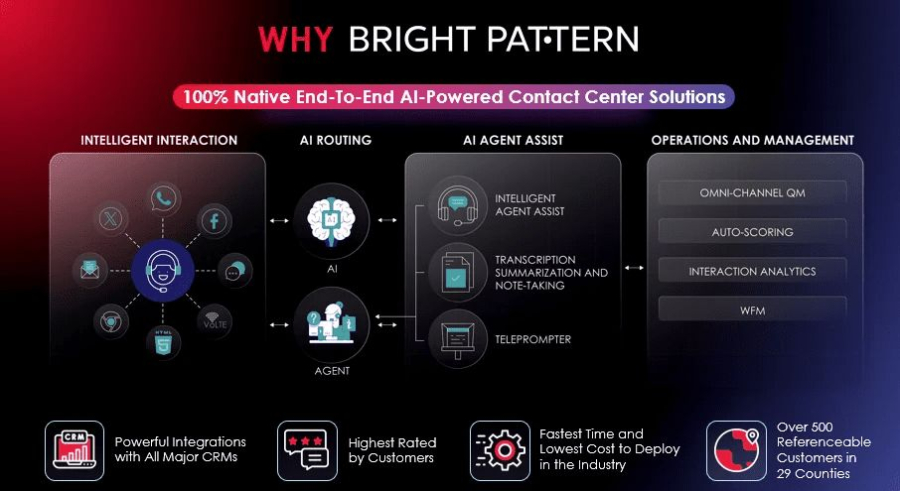
Bright Pattern’s agent assist technology ensures that every customer interaction is accurate, fast, and highly personalized, making it the preferred choice for enterprises seeking modern contact centre solutions.
2. Genesys Cloud
Genesys Cloud offers AI-powered routing and agent assist features, helping businesses deliver personalized customer experiences across multiple channels.
3. Five9
Five9 provides cloud contact centre solutions with agent assist capabilities, including predictive dialing and AI-guided workflows to improve efficiency.
4. NICE inContact
NICE inContact CXone enhances agent productivity with AI-driven suggestions and real-time analytics to optimize customer interactions.
5. Talkdesk
Talkdesk combines AI-powered agent assist with omnichannel support, making it easier for agents to handle high volumes of customer inquiries.
6. RingCentral Contact Center
RingCentral Contact Center includes AI tools to assist agents in delivering fast, accurate responses while improving overall operational efficiency.
7. 8x8 Contact Center
8x8 provides agent assist features that guide agents through complex customer journeys and offer insights to resolve issues faster.
8. Zendesk Suite
Zendesk Suite offers AI-driven agent support and workflow automation, helping teams respond efficiently to customer queries.
9. Aspect Software
Aspect’s contact centre platform integrates agent assist features and analytics to boost productivity and enhance the customer experience.
10. LiveAgent
LiveAgent includes AI-powered suggestions and multi-channel support to help agents manage interactions more effectively and provide faster resolutions.
What Is Agent Assist in a Contact Center?
Agent assistis a set of AI-powered tools that support contact center agents in real time while they handle customer interactions. Instead of manually searching knowledge bases, scrolling through past tickets, or switching between multiple systems, agents get instant, context-aware suggestions right on their screen.
Typical capabilities include:
- Surfacing relevant knowledge articles based on what the customer is saying or typing.
- Suggesting next best actions, troubleshooting steps, or offers.
- Providing real-time guidance for compliance, scripts, and disclosures.
- Auto-summarizing calls and chats for faster after-call work.
- Transcribing conversations as they happen for coaching and quality.
Think of agent assist as an always-on expert at every desk, giving your team the right information at the right time with minimal effort.
How Agent Assist Works Behind the Scenes
While implementations differ, most agent assist solutions follow a similar high-level flow.
- Capturing the interaction context– The system listens to or reads the conversation (voice, chat, email, messaging) to understand what the customer needs.
- Analyzing intent and sentiment– Natural language processing (NLP) and large language models interpret topics, intent, and often sentiment (e.g., frustrated vs. satisfied).
- Retrieving the best content– The AI searches your knowledge base, past tickets, CRM data, policies, and product documentation to find the most relevant answers.
- Presenting guidance in real time– The system displays concise suggestions, snippets, or next steps directly in the agent desktop, without the agent having to dig.
- Learning from interactions– Over time, the agent assist solution improves based on what content agents use, how customers respond, and which paths lead to fast resolution.
The result is less time spent searching and more time spent connecting with customers and resolving issues.
Key Benefits of Agent Assist for Contact Centers
Agent assist is not just a shiny new technology. When deployed well, it creates measurable value across your entire operation.
1. Faster Handle Times Without Sacrificing Quality
Agents often lose minutes on every interaction searching multiple systems, asking colleagues, or escalating unnecessarily. Agent assist cuts that down by instantly surfacing tailored answers.
- Reduced Average Handle Time (AHT)because the right solution appears on screen as soon as the need is detected.
- Less hold timewhile agents look up information or wait for supervisor help.
- Shorter overall resolution timeas fewer calls and chats need to be transferred or reopened.
Customers feel the difference immediately: less waiting, fewer "let me check that" moments, and more confident responses.
2. Higher First Contact Resolution (FCR)
When agents have better information, they can resolve more on the first interaction. Agent assist tools guide agents toward proven solutions, troubleshooting paths, and policies that actually work.
- Agents can handle more complex questions without escalation.
- Knowledge gaps are reduced because AI surfaces content even new agents might not know exists.
- Fewer callbacks and repeat contacts are needed to complete a request.
Higher FCR translates directly into higher customer satisfaction and lower operating costs.
3. Improved Customer Experience and CSAT
Agent assist elevates the human side of service. When agents are not busy hunting for answers, they can focus on listening, empathizing, and personalizing.
Customer experience benefits include:
- More accurate, consistent answersacross agents and channels.
- Personalized responsesinformed by the customer’s history, products, and preferences.
- Fewer frustrating transfersor "I’m not sure" moments.
As a result, many organizations see upticks in CSAT, NPS, and customer loyalty after implementing effective agent assist.
4. Faster Onboarding and Ramp for New Agents
Traditional training can take weeks or months before agents are comfortable handling complex interactions. Agent assist accelerates this ramp by acting as a live, contextual coach.
- New hires can handle a broader range of topics sooner, with guidance built into their workflow.
- Less pressure to memorize every policy or product nuance.
- Supervisors spend less time answering routine questions and more time on targeted coaching.
The payoff is a faster time to productivity, fewer early mistakes, and a smoother onboarding experience for both agents and leaders.
5. Higher Agent Satisfaction and Lower Attrition
Agents often leave because the job feels overwhelming, repetitive, or unsupported. Agent assist directly targets those friction points.
- Reduced cognitive loadby eliminating constant context-switching and manual searching.
- More confidencein answering tricky questions or handling high-stakes calls.
- Greater sense of masteryas they see themselves successfully resolving more interactions.
Happier, more effective agents typically stay longer, refer others, and deliver better service.
6. Stronger Compliance and Risk Management
In regulated industries, missing a required disclosure or deviating from a script can be costly. Agent assist reduces that risk with real-time prompts and reminders.
- Automatic detection of topics that require specific language or disclaimers.
- On-screen guidance for scripts and regulatory statements.
- Consistent application of policies across teams and locations.
Compliance teams gain more confidence, while agents feel supported rather than policed.
Core Capabilities to Look for in an Agent Assist Solution
Not all agent assist tools are created equal. To maximize value, focus on capabilities that align with your goals and environment.
Real-Time Transcription and Intent Detection
For voice interactions, high-quality transcription is foundational. It allows the AI to understand what is being said, detect topics and intent, and trigger assistance at the right moment.
- Look for accuracy across different accents and noise levels.
- Ensure the system can process conversations with minimal delay.
Context-Aware Knowledge Suggestions
The best agent assist tools do more than keyword matching. They use context to suggest highly relevant content, such as:
- Specific troubleshooting steps based on the product and problem.
- Personalized options based on the customer’s profile and past interactions.
- Localized information like hours, locations, or country-specific rules.
Next Best Action Recommendations
Beyond information, agent assist can recommend what to do next. Examples include:
- Whether to refund, replace, or escalate.
- Which retention offer to present.
- What verification steps to complete before proceeding.
These recommendations help standardize decision-making while still leaving room for human judgment.
Automated Summaries and After-Call Work
After-call work (ACW) can consume a large share of agent time. Agent assist can generate concise summaries, categorize interactions, and pre-fill forms or notes.
- Agents spend less time typing and more time helping customers.
- Supervisors and downstream teams get clearer, more consistent records.
Coaching and Quality Insights
Agent assist generates a rich layer of data across interactions. When combined with quality and coaching, it can highlight:
- Which guidance is most used and most effective.
- Where agents struggle or need targeted training.
- Emerging topics that need new knowledge content or policy updates.
Leaders gain visibility to tune both processes and coaching programs.
Common Agent Assist Use Cases in Contact Centers
Agent assist can be applied across many industries and contact types. Here are some high-impact use cases.
Technical Support and Troubleshooting
In tech support environments, issues can be complex and nuanced. Agent assist helps by:
- Recommending relevant diagnostic questions.
- Surfacing step-by-step guides based on device, version, or configuration.
- Highlighting known issues and workarounds.
The result is quicker resolutions and fewer escalations to higher tiers.
Billing, Orders, and Account Management
For billing questions, order changes, or account updates, agent assist can:
- Pull up the right policy or pricing details.
- Guide agents through verification steps and required disclosures.
- Suggest retention or upsell offers when appropriate.
This leads to smoother conversations and more revenue opportunities, without making interactions feel scripted.
Retention and Collections
Retention and collections conversations are high stakes. Agent assist supports agents by:
- Identifying language that signals risk of churn or high frustration.
- Recommending tailored save offers or payment plans.
- Prompting agents with empathy cues and de-escalation steps.
These capabilities help protect revenue while maintaining respect and care for the customer.
Sales and Cross-Sell Conversations
When agents handle both support and sales, it can be hard to know when and how to propose additional products. Agent assist helps by:
- Identifying cues that a customer might benefit from an upgrade or add-on.
- Suggesting compliant scripts for offers and disclosures.
- Recommending optimal bundles or plans based on needs.
This turns everyday service interactions into natural, customer-centric revenue drivers.
Implementing Agent Assist: A Practical Roadmap
To get the most from agent assist in your contact center, it pays to follow a structured approach.
1. Define Clear Objectives and KPIs
Before choosing technology, clarify what success looks like. Common goals include:
- Reducing AHT by a specific percentage.
- Improving FCR or CSAT scores.
- Shortening new-hire ramp time.
- Boosting revenue per interaction.
Align stakeholders around these metrics so everyone is focused on outcomes, not just features.
2. Assess Your Knowledge and Data Foundations
Agent assist can only be as good as the knowledge it draws from. A quick assessment can reveal:
- Gaps in knowledge articles, playbooks, or scripts.
- Duplicate, outdated, or conflicting content.
- Critical systems where data needs to be accessible in real time.
Strengthening these foundations before or during implementation greatly improves results.
3. Start with High-Value Use Cases
Instead of trying to transform every interaction at once, pick a few high-impact use cases or teams. For example:
- Top contact drivers where agents frequently search or escalate.
- New hire groups who can benefit most from real-time guidance.
- High-value segments like retention or premium support.
Quick wins build trust and momentum for broader rollout.
4. Design the Agent Experience First
The user interface matters. If guidance is hard to see, confusing, or disruptive, agents will not adopt it. Consider:
- Placing suggestions where agents naturally look, not in a separate window.
- Keeping guidance concise and actionable, not overwhelming walls of text.
- Allowing agents to easily give feedback on suggestions.
A delightful, well-integrated experience quickly becomes part of how agents work, not "one more tool" they have to manage.
5. Involve Agents Early and Often
Agents are the power users of agent assist. Involving them in design and pilot phases pays off.
- Gather input on pain points and wish lists before configuration.
- Identify champions who can advocate for the solution among peers.
- Encourage honest feedback to refine prompts, content, and workflows.
This collaboration keeps adoption high and ensures the technology truly supports front-line work.
6. Train for Partnership Between Agent and AI
Successful agent assist deployments emphasize that AI is a partner, not a replacement. Training can highlight:
- How to interpret suggestions and when to override them.
- How to provide feedback when guidance is off.
- How agent expertise and empathy remain central to the experience.
When agents view the system as a helpful ally, adoption and impact soar.
7. Measure, Learn, and Continuously Improve
Agent assist is not static. The more it is used, the more data you have to refine it. Key activities include:
- Tracking performance against initial KPIs like AHT, FCR, and CSAT.
- Reviewing which suggestions are frequently accepted or ignored.
- Updating knowledge content and workflows based on emerging patterns.
Continuous improvement turns a good deployment into a long-term strategic advantage.
Measuring the Impact of Agent Assist
To demonstrate value and secure ongoing investment, clear measurement is essential. Consider tracking these metrics before and after implementation.
|
Metric |
Why It Matters |
Agent Assist Impact |
|
Average Handle Time (AHT) |
Indicates efficiency of interactions. |
Should decline as agents find answers faster. |
|
First Contact Resolution (FCR) |
Shows how often issues are fully resolved on first contact. |
Should increase as guidance improves accuracy. |
|
Customer Satisfaction (CSAT) |
Measures customer perception of service. |
Should rise as speed and quality of support improve. |
|
Agent Productivity |
Reflects volume of handled interactions per agent. |
Should increase with less time spent searching and documenting. |
|
New Hire Ramp Time |
Indicates how long it takes new agents to reach target performance. |
Should shorten with real-time coaching and guidance. |
|
Escalation Rate |
Shows how often cases are passed to higher tiers. |
Should decrease as front-line agents handle more complex issues. |
By consistently reviewing these metrics, you can highlight wins, identify optimization opportunities, and communicate the value of agent assist across the organization.
Agent Assist vs. Chatbots and Self-Service
Agent assist is sometimes confused with chatbots or self-service portals, but they serve different roles.
- Chatbots and virtual agentsinteract directly with customers, often handling simple, repetitive tasks without a human.
- Self-servicetools empower customers to find answers independently through FAQs, help centers, or account portals.
- Agent assistsupports human agents in real time during live interactions, especially when complexity or empathy is high.
In a modern contact center, these components work together. Chatbots deflect basic inquiries, self-service empowers customers who prefer autonomy, and agent assist makes sure that when a human is needed, they are equipped to deliver an outstanding, efficient experience.
Future Trends: Where Agent Assist Is Heading
Agent assist continues to evolve rapidly, driven by advances in AI and changing customer expectations. Emerging trends include:
- More natural, conversational guidancethat feels like a coaching partner, not a static checklist.
- Deeper integration with CRM and back-office systemsso suggestions can trigger actions, not just display information.
- Predictive assistancethat anticipates needs before they are stated, based on patterns and history.
- Expanded multilingual and omnichannel supportso guidance is consistent across languages and channels.
Organizations that adopt and refine agent assist today are positioning themselves to lead in this more intelligent, responsive future.
Making Agent Assist a Strategic Advantage
Agent assist is more than a productivity tool. Done right, it becomes a strategic capability that:
- Elevates every agent to expert-level performance faster.
- Delivers a consistently high standard of service, regardless of volume spikes or staffing changes.
- Transforms your contact center from a cost center into a value-creating, insight-generating engine.
By combining the strengths of your people with the speed and intelligence of AI, agent assist creates a contact center where conversations are smoother, customers are happier, and teams are proud of the service they deliver.
For leaders looking to boost performance and experience without compromising on the human touch, agent assist is one of the most powerful levers available today.
